Released on Oct 27. 2026
WPT padel courts and panoramic padel courts are both popular choices for professional sports facilities and modern padel clubs. They share several features, including tempered glass walls, reinforced steel structures, artificial turf, and regulation playing dimensions.
The main difference lies in their design priorities and specific configurations. WPT-style courts emphasize professional playing requirements and tournament-oriented features, while panoramic courts focus on open sightlins and reducing visual obstructions.
However, these categories can overlap. A WPT-style court may also feature a panoramic enclosure.

A WPT padel court is a professional-style court designed for competitive play, training centers, and tournament venues.
It combines a reinforced structural framework with high-performance playing components.
Typical features include:
Panoramic back walls with tempered glass.
Reinforced steel connections and anti-vibration components.
Artificial turf suitable for intensive play.
LED lighting for competitive playing conditions.
WPT-style configurations generally place particular emphasis on structural stability, playing performance, and spectator visibility.
A panoramic padel court is designed to provide clearer views of the playing area by reducing structural posts around the glass enclosure.
Unlike a conventional framed court, its panoramic design creates a more open appearance for players and spectators.
Panoramic courts are available in different structural configurations.
Panoramic Court: Reduces visual obstructions, particularly around the back glass walls.
Full Panoramic Court: Further minimizes visible supports to create broader viewing angles.
Both designs require carefully engineered glass connections and structural reinforcement to maintain stability.
Panoramic courts are commonly used in sports clubs, tournament venues, resorts, and facilities designed for match recording or live streaming.
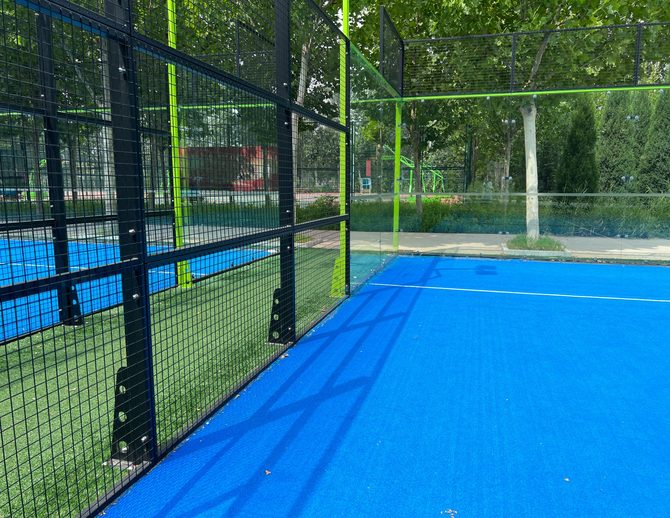
Although the two designs share many components, their configuration priorities may differ.
| Feature | WPT Padel Court | Panoramic Padel Court |
|---|---|---|
| Main design focus | Professional playing conditions and tournament-oriented configuration | Open sightlines and panoramic presentation |
| Glass enclosure | Often features a panoramic back wall | Panoramic or full-panoramic glass arrangement |
| Steel framework | Reinforced frame with anti-vibration connections on some models | Engineered frame designed to reduce visual obstructions |
| Glass thickness | Commonly 12 mm tempered glass | Commonly 12 mm tempered glass |
| Playing dimensions | 20 m × 10 m | 20 m × 10 m |
| Lighting | Competition-oriented LED configuration | LED configuration based on facility requirements |
| Typical applications | Professional training, tournaments, sports clubs | Clubs, tournaments, resorts, spectator-oriented venues |
These are typical product characteristics rather than fixed technical classifications. Actual specifications depend on the selected model and manufacturer.
WPT-style courts often emphasize reinforced joints and vibration control to maintain structural stability during intensive use.
Panoramic courts focus on reducing visible support posts while maintaining adequate strength around the glass enclosure.
Both designs require appropriate steel profiles, secure glass mounting, and engineered foundation connections.
Both types commonly use 12 mm tempered glass, especially in professional panoramic models.
The main difference is not necessarily the glass thickness but the arrangement of panels, connections, and surrounding support structures.
Panoramic courts are specifically designed to reduce visual obstructions around the playing area.
WPT-style courts can provide similar visibility when equipped with panoramic back walls or full-panoramic structures.
For facilities hosting tournaments or recording matches, the actual location of posts, lighting equipment, and spectator seating matters more than the court's product name.
No. Both follow the standard padel playing dimensions established by the International Padel Federation (FIP).
The internal playing area measures 20 meters long and 10 meters wide, regardless of whether the court is marketed as WPT-style or panoramic.
Key requirements include:
Net height: 0.88 m at the center and 0.92 m at the ends.
Service line distance: 6.95 m from the net.
Clear height: At least 6 m, with 8 m recommended for new facilities.
Additional structural specifications, including steel profiles, glass arrangements, and lighting systems, depend on the selected model.
You can learn more about regulation requirements in our guide to padel court dimensions.
The right choice depends on how the court will be used and which technical features are most important.
Your facility focuses on competitive training or professional-style matches.
Reinforced structural connections are an important requirement.
You need a court configuration tailored to tournament-oriented lighting and playing requirements.
Tournament-oriented lighting and playing specifications are priorities.
Unobstructed spectator views are a major priority.
Your club regularly hosts exhibitions or social events.
You want a visually open design for match recording.
The court is part of a premium club, resort, or commercial development.
These options are not mutually exclusive. A professionally configured panoramic court can support both competitive play and spectator-oriented applications.
Rather than relying only on product names, compare the actual specifications offered by the manufacturer.
Pay particular attention to:
Glass layout: Panel dimensions, thickness, and mounting details.
Structural connections: Steel profiles, reinforced joints, and anchoring systems.
Playing conditions: Turf specifications, lighting uniformity, and overhead clearance.
Installation environment: Indoor or outdoor location, wind exposure, and drainage.
Intended use: Recreational play, professional training, or tournament events.
If you are planning an outdoor facility in an area with frequent rain or strong sunlight, a covered padel court may also be worth considering.
Ultimately, the choice between a WPT-style court and a panoramic court should be based on the actual structural design, playing requirements, and viewing experience rather than the product name alone.
Whether you're planning a WPT-style court or a panoramic padel court, we offer customized padel court solutions tailored to your facility requirements. Contact us to discuss your project.
CUSTOMIZED OPTIONS AND PARAMETERS
Our team is composed of experienced experts who are eager to help you find a solution that suits your business.
RECENT NEWS
RELATED PRODUCTS